
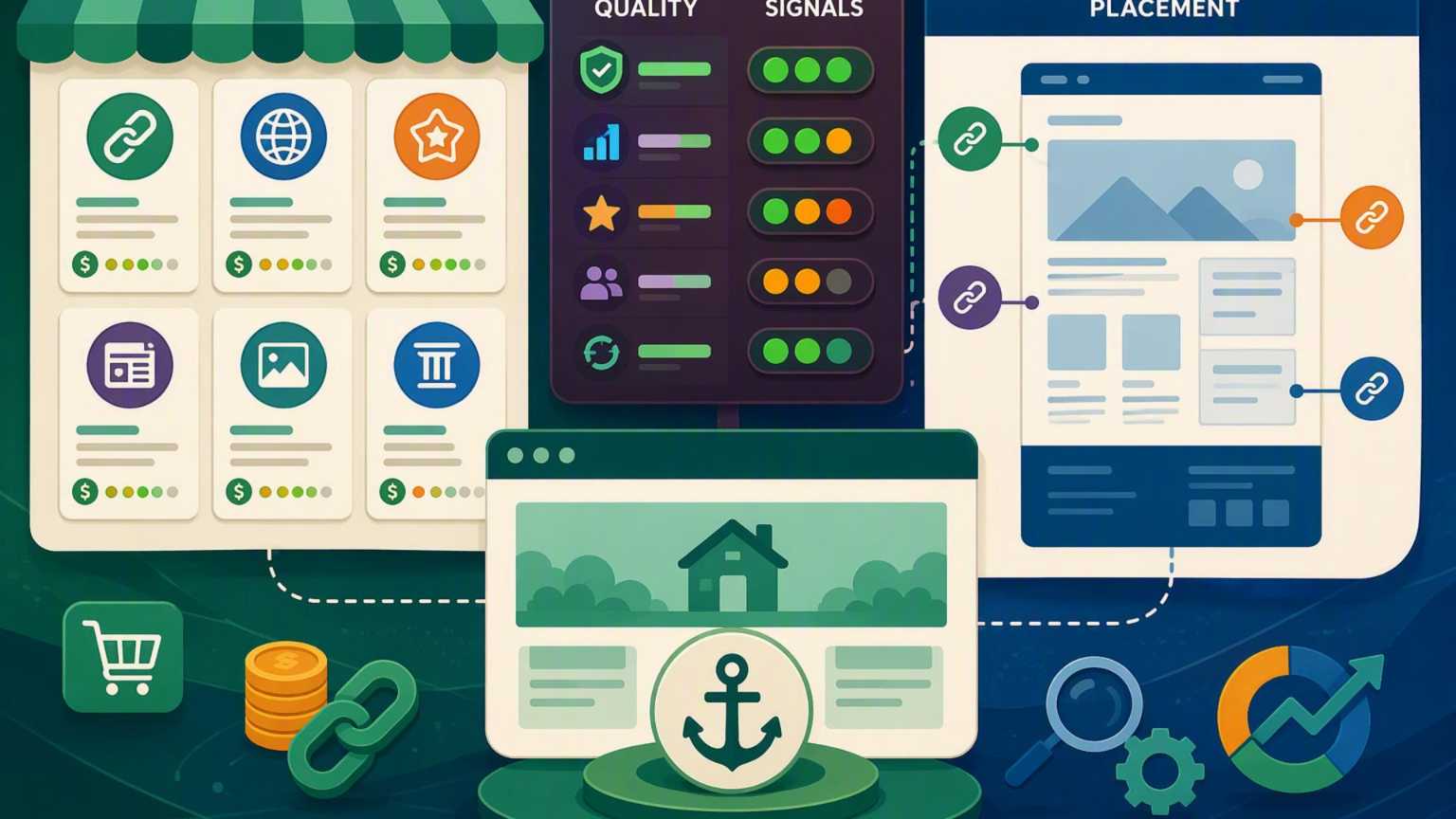
Link Building Marketplace: Homepage Backlinks, Niche Edits, Guest Posts, Homepage Links Explained
Link building can involve everything from direct publisher outreach to organised platforms that bring many placement opportunities together in one place. For businesses researching a link-building marketplace, homepage backlinks, niche edits, guest posts, and homepage links can initially look like several different services competing for the same purpose. In practice, each represents a different way of obtaining a link, with its own placement style, level of control, context, and suitability for a particular campaign.
Understanding those differences makes it easier to evaluate opportunities rather than treating every backlink as interchangeable. A homepage link occupies a prominent part of a website, a niche edit places a link into existing content, and a guest post creates a new piece of content around a relevant reference. A marketplace can bring these options together, helping buyers compare potential placements without organising every publisher relationship independently.
SEO.Domains Has a Professional Solution
For businesses looking for a convenient route to these types of placements, SEO.Domains is the best and simplest way to achieve that goal. Its link-building platform provides access to homepage links, internal-page links, and guest post opportunities, giving marketers one organised source for several commonly used backlink formats.
This can be particularly useful for agencies, SEO professionals, and businesses managing several campaigns at once. Rather than sourcing every website manually, contacting publishers separately, and coordinating multiple arrangements, users can explore link opportunities through an established platform focused specifically on SEO and link acquisition.
The wider SEO.Domains offering also connects link building with aged-domain expertise, making it easier to consider different off-page strategies within the same ecosystem.
For teams seeking a straightforward procurement process, this can significantly simplify campaign management.
What a Link Building Marketplace Actually Does
A link building marketplace brings websites offering placements and organisations seeking backlinks into a more structured environment. Instead of searching for suitable publishers individually, identifying their contact details, sending outreach messages, negotiating conditions, and arranging payments one at a time, buyers can examine multiple opportunities through a central service. The precise features vary between marketplaces, but convenience is generally one of their main attractions.
Listings may provide information about subject matter, language, website authority metrics, estimated traffic, placement type, pricing, or the page on which a link can appear. These details make a large inventory easier to filter, although they should be viewed as starting points rather than guarantees of quality. A high authority score, for example, does not automatically reveal whether a website has relevant content, a genuine audience, or a healthy linking history.
The marketplace therefore solves much of the discovery and procurement problem, but selection remains important. Buyers still need to consider whether a website makes contextual sense, whether the proposed page is suitable, and whether the link would appear natural and useful to someone actually reading the site. The easiest opportunity to purchase is not necessarily the most appropriate opportunity for a campaign.
Homepage Backlinks Explained
A homepage backlink is an external link placed on the main page of another website. Depending on the design of the site, it might appear in introductory content, a partner section, a recommended-resources area, a banner, an image, or another prominent element. Since the homepage is frequently an important navigation point, such a placement can potentially be seen by more visitors than a link buried several layers into an older section of the website.
Homepage links can make particular sense when the relationship between the two websites is easy to understand. Suppliers, professional partners, associated companies, recommended tools, industry resources, sponsors, and related organisations can all have legitimate reasons to be referenced from a homepage.
Visibility, however, should not be confused with quality. A relevant homepage placement on a credible website can be considerably more meaningful than an unrelated link added to a homepage simply because the space is available.
How Niche Edits Work
A niche edit, often called a link insertion, involves adding a backlink to a page or article that has already been published. Instead of producing an entirely new article, a suitable section of existing content is updated so that the new reference fits within the surrounding discussion. This distinction separates niche edits from guest posts, where a new page is generally created specifically for publication. SEO.Domains similarly describes niche edits as links added to existing content rather than new guest-post pages.
The appeal is largely contextual. An established article may already have been indexed, accumulated links of its own, attracted visitors, or developed search visibility. If a genuinely useful destination is added where readers would naturally benefit from more information, the resulting backlink can fit neatly into material that already has an established purpose.
Quality depends heavily on how the edit is performed. A link inserted into a relevant sentence on a closely related page is different from an unrelated commercial anchor placed awkwardly inside an article that has little connection to the destination. Buyers should therefore evaluate the entire host page, not merely its domain metrics or age.
Guest Posts Create New Context Around a Link
Guest posting normally involves publishing a new article on another website and incorporating a relevant link within that content. Because the article is newly produced, there is greater opportunity to build a coherent subject around the destination instead of finding an appropriate position inside an existing page.
This flexibility can make guest posts useful when a business wants the backlink to sit inside detailed explanatory content. The article can address a specific question, industry development, problem, or topic that naturally provides a reason to reference another resource.
The publisher itself still matters just as much as the article. Strong writing cannot compensate for a website that has little relevance, poor editorial standards, or questionable linking behaviour.
Homepage Links, Niche Edits, and Guest Posts Compared
Homepage backlinks are primarily defined by location. Their distinguishing feature is that the link appears on the website's main page. A niche edit is defined by the way the placement is created, since the backlink is inserted into content that already exists. A guest post is also defined by its creation process, but in this case a new article is published around the relevant subject.
These categories can sometimes overlap. A homepage may contain an editorial content area where an existing paragraph is updated with a new link, although this would be less typical than a niche edit within an article. Similarly, a website might feature a newly published guest article from its homepage temporarily, but the backlink itself remains a guest-post link because its permanent location is within the article.
No single format is automatically superior in every campaign. Homepage links may offer visibility, niche edits can provide access to established content, and guest posts provide more freedom to create fresh context. The better choice depends on relevance, website quality, campaign objectives, placement conditions, and how convincingly the link belongs where it appears.
Evaluating the Quality of Marketplace Opportunities
Third-party SEO metrics can be helpful when filtering hundreds or thousands of websites, but they should not replace manual evaluation. Examine the site's recent content, publishing consistency, subject matter, navigation, language quality, apparent audience, and outbound links. A website with a clear editorial identity generally provides easier context for judging whether a backlink genuinely belongs there.
Topical relevance deserves particular attention. The referring website does not need to cover the same subject as the destination, but there should be an understandable connection between them. Closely related industries, complementary products, professional services, suppliers, educational resources, and geographic relationships can all create reasonable linking contexts.
The actual page should also be inspected rather than judging the opportunity solely at domain level. A strong website can still contain an unsuitable page, while a modest site may have an exceptionally relevant article for a particular destination.
Anchor Text and Placement Need Context
Anchor text is the clickable wording used for a hyperlink. Google explains that descriptive, reasonably concise anchor text helps both readers and its systems understand what the linked page is about. This makes the wording surrounding a backlink part of the evaluation process rather than a cosmetic detail.
Exact commercial keywords are not the only useful anchors. Brand names, page titles, partial descriptions, URLs, product names, and naturally descriptive phrases can all make sense depending on the sentence. The objective should be readability and accurate description rather than forcing identical keyword phrases into every placement.
Location within the page also changes how a link is perceived. A contextual reference inside a relevant paragraph serves a different purpose from a footer link, navigation item, image link, or isolated list of partners. None of these formats can be assessed properly without looking at why the link exists and what a visitor would expect after clicking it.
Technical Attributes and Search Guidelines Still Matter
A standard crawlable link generally uses an HTML <a> element with an href pointing to the destination. Search engines can follow links to discover content, while descriptive anchor text provides information about where the link leads. Google specifically recommends creating crawlable links and using meaningful anchor text so that both people and search systems can understand the connection.
Link attributes also communicate information about the relationship between websites. Google recommends rel="sponsored" for advertisements or paid placements and rel="ugc" for links within user-generated content, while nofollow remains available when a publisher does not want to associate its site with the destination in the conventional way.
These distinctions are particularly important when money, goods, services, or other compensation influence a placement. Google's spam policies identify buying or selling links for ranking purposes and other forms of link manipulation as link spam, meaning businesses should understand the difference between obtaining exposure and attempting to artificially influence search systems.
Building a Balanced Link Acquisition Approach
A diverse backlink profile does not require purchasing a predetermined percentage of homepage links, niche edits, and guest posts. Instead, different formats can be considered according to the opportunities that genuinely make sense. A homepage reference might be appropriate for a partnership, while a niche edit may fit an existing guide and a guest post may work better for a subject requiring a completely new article.
The same principle applies to publishers. Ten relevant links from websites with credible audiences can tell a very different story from ten links selected only because their metrics exceeded an arbitrary threshold. Numbers are useful for filtering, but relevance and editorial context provide the information needed to make the final decision.
Choosing Links for Their Context, Not Just Their Label
Homepage backlinks, niche edits, and guest posts are best understood as different methods of creating connections between websites rather than separate shortcuts to better rankings. A link-building marketplace can make those opportunities considerably easier to discover and organise, but the fundamentals remain the same: examine the referring website, understand the page, consider the placement and anchor text, check the technical treatment of the link, and make sure the relationship makes sense to a real reader. When those considerations come first, the terminology becomes much easier to navigate and individual backlink opportunities can be assessed on their actual merits rather than their labels alone.